Video Information
A video on KolorTube is an ordinary WordPress post with the video post format. What makes it play, and what the theme shows around it, comes from the KolorTube - Video information box below the editor.
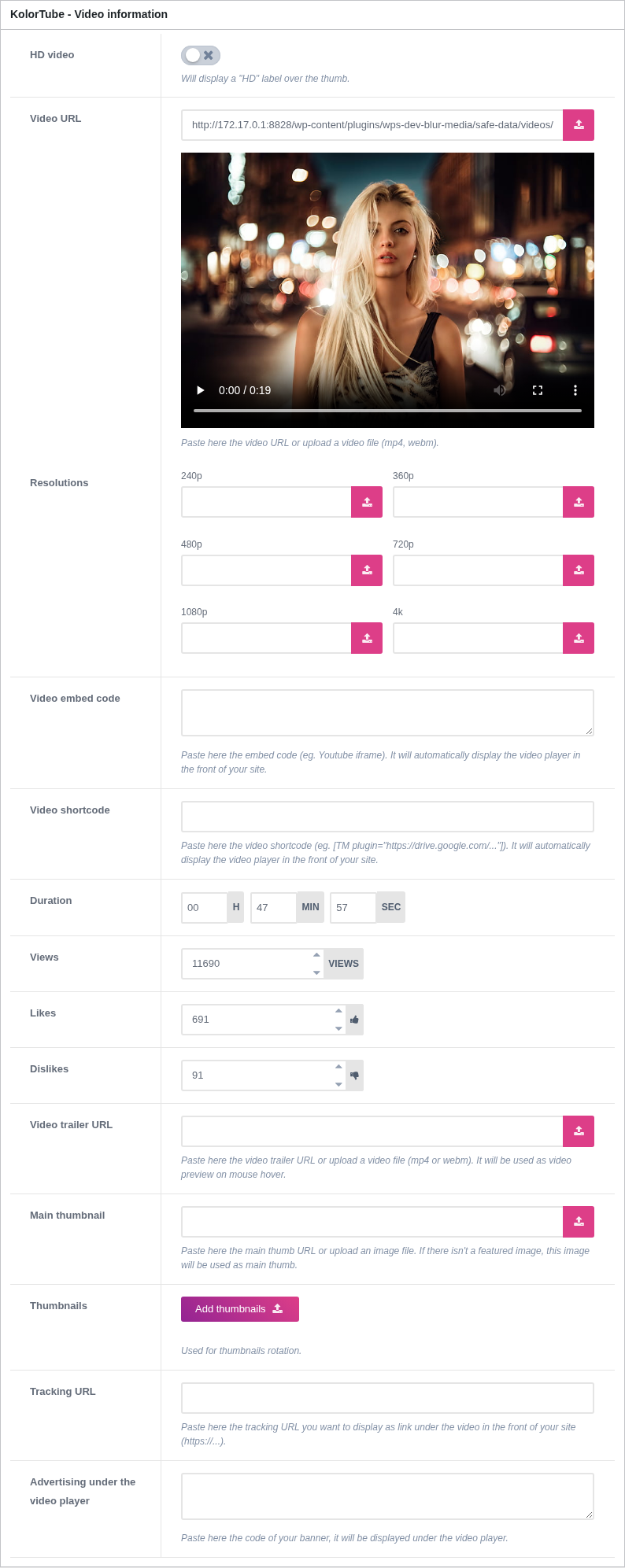
1. The short version
A video needs one source and one thumbnail. Everything else is optional and can be filled in later:
| Field | Needed |
|---|---|
| Video URL, or Video embed code, or Video shortcode | One of the three |
| Main thumbnail, or the post's featured image | One of the two |
| Duration | Recommended, it is shown on every thumbnail |
| Everything else | Optional |
2. HD video
Prints an HD label over the thumbnail. It is a label and nothing more: it does not check the file, and it does not change how the video is served. Setting it on a low resolution clip simply lies to your visitors.
3. The video source
The three source fields are alternatives. Fill in the one that matches where your video lives.
Video URL takes a direct link to an mp4 or webm file, or an upload from your media library. This is the field to use for videos you host yourself. Once it is filled, the box shows a working player, so you can check the file plays before publishing.
Video embed code takes the iframe a provider gives you, YouTube and the tube sites included. Paste it as handed over, without editing it: the theme prints it as is.
Video shortcode takes a shortcode from a player plugin, for sources an iframe cannot cover.
Resolutions
Under the Video URL, six fields accept one file per quality: 240p, 360p, 480p, 720p, 1080p and 4k. Fill in as many as you have and the player offers the visitor a quality switch. Leave them empty and the player just uses the Video URL.
These only apply to files you host. A provider's embed carries its own quality menu, so the fields do nothing there.
4. Duration
Three boxes: hours, minutes, seconds. The theme stores the total in seconds and prints it on every thumbnail.
Leaving it empty is not a crash, but it looks unfinished: the badge disappears from the grid while its neighbours keep theirs.
5. Views, likes and dislikes
The three counters the theme displays. They rise on their own as visitors watch and vote, so you never have to touch them.
They are editable because a new site has nothing to show, and a grid of videos at zero views reads as an empty site. Setting a plausible starting figure is a normal thing to do on launch day.
6. Video trailer URL
A short clip played on mouse hover over the thumbnail, which is what makes a tube grid feel alive. Takes a file URL or an upload, same as the Video URL.
Hover previews have to be switched on for this to show, in General.
7. Thumbnails
Main thumbnail is the image used in every grid on the site. If you leave it empty, the post's featured image is used instead, so either one works, and the featured image is usually the simpler route.
Thumbnails takes several images at once, for the rotation effect: hovering a video cycles through them. Like the trailer, rotation is switched on in General.
8. Tracking URL
Prints a link under the video, which the theme labels with the text you set in SEO → Single video pages.
This is the field to use for an affiliate link, when the video is a teaser for something you earn on. Leave it empty and nothing is shown.
9. Advertising under the video player
An ad zone specific to this one video, printed under the player. It is there for the cases the global zones cannot cover, a sponsored video for instance.
For the ad zones on every video, use Advertising → Single video page instead: setting them once beats pasting the same code into every post.
10. Where to go next
- Video Submission if you want visitors to send videos in.
- Options for the settings that decide what the theme does with these fields.